Wednesday, November 12, 2014

CONVENTIONS OF HORROR GENRE

CONVENTIONS OF HORROR GENRE:


Secluded Locations:
  • Most horror films put their characters in locations where they cannot get any help, and help can't reach them. 
  • These include abandoned towns, empty houses, forests, campsites and old amusement parks.


Examples of films:

  • Alien - Space
  • Parnormal Activity - House
  • Blair Witch Project - Forest

Characters forget about danger/threat:
  • Characters conveniently forget the danger/events that have happened. 
  • Then they go out, expecting nothing to happen. 
  • This is often when the antagonist attacks.

Examples of films:
  • Jaws - tourist still go into the ocean
  • The Happening - They think the attacks are over, a scream at the end signifies that it isn't

Jump scares and fake scares:
  • Fake scares are scares in films which are not connected to a direct threat, and jump scares are where something/someone jumps out unexpectedy and scares the audience.
Films:
  • Aliens vs Predators - penguin jumps out of nowhere
  • Jaws - Head in the boat, shark jumping out to the boat
  • The Shining 

Warnings go unheeded:

  • This relies on part of human nature;the desire to go where we have been told not to go and do what we have been told not to do. 
Films:
  • The Final Destination series - Characters don't pay attention to the warnings and prophecies from the protagonist(s).
  • Jaws - Tourists ignore Cheif Brody's warning, leading to more deaths.

Technical Codes:
  • Camera work is very expensive and not natural; high and low an angle connotes fear.
  • POV shots are important because they allow the audience to see the world from the monsters eyes.
  • Sometimes framework uses depth of field, makes it harder to see the monster creeping up.

Character Types:
  • The main protagonist, often the ‘victim/hero’ of the movie.        
  • The villain, often a monster, mutated freak, alien or serial killer – tend to have a trademark characteristic as to how they kill (e.g. weapons, and who they kill)
  • The stupid/immoral teenagers that always get killed
  • Creepy children
  • Police officers (either good or bad)
  • Many others: Ghosts, zombies, demons, psychopath, stalker, weirdo, werewolf, cheerleader etc…

Themes:
  • Good vs Evil
  • Depression
  • Religion
  • Childhood issues
  • Revenge
  • Supernatural
  • Beyond death
  • Science gone bad
  •  Zombie Apocalypse 
  • Nightmares
  • Madness
  • Insanity
  • Lust
  • Envy
  • Suicide
  • ‘self-consciousness’ – making you question what is real and not.

Special Effects Make-up:
  • Prosthetic makeup (also called FX prosthesis) is the process of using prosthetic sculpting, moulding & casting techniques to create advanced cosmetic effects.

Props used:
  • Machete
  • Knife
  • Axe
  • Chainsaw
  • Usually weapons that inflict a slow and painful death

Victims:
  • The slut (promiscuous girl) gets punished for being sexually active
  • A group of people, the audience can relate to

Saturday, November 1, 2014

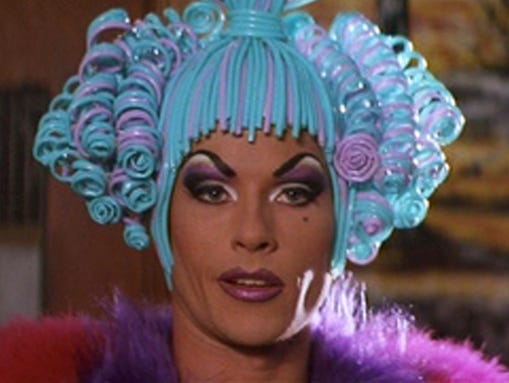
PRISCILLA QUEEN OF THE DESERT (PART B - REPRESENTATION)

THE ADVENTURES OF PRISCILLA, QUEEN OF THE DESERT - PART B - REPRESENTATION:

1. Who is the intended audience of the film.
The intended audience of the film are middle-aged women and gay men, as they enjoy the music featured in the film, such as Abba, Gloria Gaynor, etc.  The film helped bring out a positive portrayal of the LGBT individuals, that helped to introduce LGBT themes to a mainstream audience.  However, the film has also been criticized for perceived racist and sexist stereotyping.  As seen from the female being portrayed as a Filipino who is Bob's wife.

2. Select a character and make notes on how they are presented:
  • Consider their physical characteristics and personality
  • How are they represented in terms of gender?
  • Are there stereotypes presented or challenged?
  • Is the representation positive or negative or a balance of both?

Character : Adam
Actor: Guy Pearce

Physical characteristics and personality:
  • Young
  • Flamboyant
  • Obnoxious
  • Immature
How are they represented in terms of gender?
Male - Young, very happy, excited
Drag Queen - Wants to cause trouble, flamboyant

Are the stereotypes presented or challenged?
  • Challenged as they are mocked in the film, where it is ultimately is personalized with the three individuals’ experiences in the outback. 
  • For example, in one scene that stands out in my mind is when Adam is chased and beaten up by a group of men who represent the stereotypical outback masculinity. 
  • I believe that the scene breaks down the stereotypes of drags queens and reveals them as individuals who go through struggles and face dire consequences for being true to themselves.
Is the representation positive or negative or a balance of both?
  • Balance of both

PRISCILLA QUEEN OF THE DESERT (PART A - NARRATIVE)

THE ADVENTURES OF PRISCILLA, QUEEN OF THE DESERT - PART A - NARRATIVE:

Questions:
  1. Is the narrative linear or non-linear? Is there any deviation from the structure?
  2. Identify the 5 stages of the narrative based on Todorov’s theory
  3. Are there any narrative strands in the film?
  4. Which binary oppositions can you identify in the film.

Answers:

  1. The narrative is non-linear, as it follows the journey of 3 drag queens but also has flashbacks which makes it non-linear.
  2. 5 stages of the narrative:

    •  A state of equilibrium. - Tick, Adam and Bernadette leave for a drag show in a bus.
    • A disruption of that order by an event. - Bus has been vandalized with homophobic hates and they are stuck in the outback.
    • A recognition of the disorder. - Bus breaks down and they meet a middle aged mechanic, Bob, and joins them on their journey.  Adam gets beaten up by a homophobic gang where he is saved by Bob and Bernadette.
    • An attempt to fix the disorder. - Tick and Marion have a son, and Tick is nervous about exposing his son to his profession and tries to get to know his son.  Tick is surprised that his son already knows about it and fully supports his career.
    • A new equilibrium - conclusion. - Tick, Adam, Bernadette climb Uluru in full drag costume. Tick and Adam head back to Sydney while Bernadette and Bob remains at the resort.
  3. Multi strand, as it focuses on 3 drag queens instead of 1.  As well later in the film Bob, the mechanic is also added into the plot.
  4. Good and Bad, Gay and Straight, Homosexual and Heterosexual

Friday, October 31, 2014

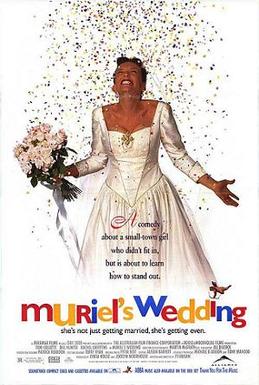
MURIEL’S WEDDING - NARRATIVE

MURIEL'S WEDDING - NARRATIVE:

The film follows a personal growth narrative structure.  where the problem is introduced in the beginning of the film, and the protagonist (Muriel) makes an attempt to overcome the problem but she fails.  As she fails she is making major mistakes, and realizes that she’s making mistakes and tries to fix them, as she is learning from her mistakes she tries to grow as a person.  The film is presented as a chain of cause and effect as it follows Muriel's story of going through up and downs in her life.  Muriel is a marriage-and-ABBA obsessed woman who lives with her family, and in which it represented a childish side of Muriel.
Due to her unattractive physical appearance and her socially awkwardness, she tries hard to real her goal of getting married. Until one day her friends decided to remove her from their group, as Muriel was considered “different” compared to her friends, which might have added to their groups status. Muriel was very depressed and she decides to steal money from her family. In the film the focus on her marriage leads her to get married for money and her relationship with Rhonda deteriorates. Her mother dies and Muriel realizes that she has to fix her mistakes and she tries to fix them.

In the film, Muriel finds a man who she doesn't really know and they go to Sydney to get married and the man has tons of money. As she marries the man, she also changes her name to Mariel showing that she has upgraded to a higher class. Things in Purpose Spit don't go well as Rhonda's cancer deteriorates and has to live in a wheel chair in the small tiny town.


Although Muriel promised to take good care of Rhonda, her best friend she secretly went out to try wedding dresses and then Rhonda found out and her relationship with Rhonda deteriorates.  Muriel also finds out that her father has an affair with Diedre, his business partner.  Muriel's personality changes and she has left Rhonda, one of her best friends to go and get married with the rich man, who is a really famous swimmer.  However, David, the swimmer, didn't really like Mariel as a wife, she just wanted to do this for the money and fame, and as well as her wish to get married.  She thought that her dream came true, and then went back home to Purpose Spit, and Rhonda told her that she wasn't the same Muriel as she had also changed her name to Mariel and acted differently.

When Muriel receives news that her mother had committed suicide to to the fact that she wasn't able to handle the pressure of divorcing and wasn't able to take care of herself, she went home as she felt guilty as she realized that she only brought sadness to people who are close to her.  She also realized that marriage without any love is pointless and so she left David and returned the money to her family as well as finding her best friend, Rhonda who went back to Porpoise Spit after the wedding.  Rhonda accepted Muriel's apology and then they left to Sydney to have an adventure, giving us a closed ending.

Thursday, October 9, 2014

GHOST - MICROANALYSIS

GHOST - MICROANALYSIS:

Whoopi Goldberg, Tony Goldwyn, Demi Moore,  Patrick Swayze

This extract is from the 1990 film Ghost, in this film Sam Wheat played by Patrick Swayze has been murdered and his girlfriend Molly played by Demi Moore is in grave danger.  Sam's ghost try to warn Molly, but she does not know it is really there. Then he meets a spiritualist named Oda Mae Brown played by Whoopi Goldberg, who can hear the dead. Sam speaks to hear and convince her to help him save Molly.  In this scene, Carl Bruner played by Tony Goldwyn goes to find Molly and wants to kill her and eventually Carl dies as he dies from a painful death as the glass from the windows falls and stabs him in the chest.

The scene starts off with a high shot of Sam and Molly, that is set in their apartment.  It has lighting coming from the sky at night and also there are a few lamps that are on.  While the high shot is going on, Carl from outside the door is knocking on the door trying to look for Molly as he wants to kill her, Sam comes out of Oda Mae’s body and Molly realizes that Carl is outside and needs to escape, and this uses special effects when Sam is leaving Oda Mae’s body.  

We then see a close up of Carl as well as using a cross cut effect that is of a two shot of Molly and Oda Mae, realizing that they need to leave the apartment as Carl is here.  In Carl’s close up, it is shot using soft low key lighting, it has non diagetic music and it is in a dark location giving us a sense that the scene is set in a mysterious setting.  As an audience it shows Carl’s determination to open the door as he wants to find Molly as well as make up has been used on Carl’s face as you can see the bright light shone onto his face, in this scene Carl is wearing a suit as he is a businessman. As Molly and Oda Mae finds a way to escape, Carl is outside the door trying to shoot the lock and gets in and it shows us a close up of Carl’s facial expressions as he is angry and determined to find Molly. 

As Carl enters the apartment, he starts walking to the middle of the apartment and starts looking around as diagetic sounds from outside the building is heard as Molly is escaping and Carl turns to the window and hears the sounds coming from the window, and is trying to control his emotions through heavy breathing which is overpowered by the music and Molly’s footsteps.  This shot is shot using a tracking shot as it follows Carl when he’s walking. 

As Carl leans out the window, he sees Molly climbing up the stairs and opens the window and it is still a tracking shot as is still hand held as you can see the camera is shaky and not still.  Then the shot continues with a medium ranged shot that is shot in soft low key lighting, in this scene there is diagetic sounds as they start hearing Carl’s footsteps and gun shots and as well as the diagetic sounds, music is being played, as well as this shot being a fast paced scene as they try to escape from Carl.  The clothing that Oda Mae is wearing in this scene is from the 90s as this film was shot in the 90s as well as she plays a spiritualist so her clothing choice is abnormal.  It is filmed as a two shot and is also a tracking shot.

While Molly and Oda Mae climb up the stairs, it then focuses on Carl who has arrived on the same floor as Molly and Oda Mae.  The tracking shot shot in low key lighting is still used as it focuses on how Carl is going to grab Molly by jumping up and down trying to reach the ladder.  In this shot, non-diagetic sounds are used as background music as the music gets intense we as the audience knows that the scenes will be getting more intense.

More tracking shots are used as Carl finds tools that he can use as his ladder and while that is going on Molly is shouting for Carl to stop, at that point Oda Mae is stuck and Carl then grabs her by the foot. Oda Mae realizes that and she is shocked, this is shot using a close up shot.  More intense music is being used as Carl pulls Oda Mae away from the ladder and brings her to the ground, this then intensifies as we see Carl sweating and Molly climbs down the ladder and tries to save Oda Mae from Carl. Bright lights hanging from above are used in this shot to show how angry Carl is as the shot is zoomed up to his face where it is shining, as well as it gives the audience an idea of how vicious Carl can get as the music slowly intensifies again.

The next scene shows an angered Carl holding a gun as he asks Oda Mae where is it referring to the money that she took from the bank and donated to charity which is in an earlier scene, it is shot using low key lighting and it is a medium shot as it only shows Carl and Molly from the waist up.  While Carl is holding a gun he starts to hear diagetic sounds coming from outside the door as Sam in his ghost form appears and tries to haunt him.

As Carl gets up, he realizes that somethings wrong and fires his gun to scare Sam in ghost form away, and at that time he gets up he grabs Molly and starts acting crazy as he demands the money or else he will kill her.  

This scene is shot from a left side view and Carl starts hearing diagetic sounds coming from the outside and starts to get scared, we as the audience then think to ourselves what on earth is going on in this haunted place.  We can see by his facial expressions that Carl is scared and as well as his facial expressions we can also see it through him shaking while holding his gun against Molly’s head.  Sam as a ghost form appears and this is done using special effects as Carl’s gun flies away from his hand when Sam is invisible. 

As Molly escapes, we can see that Carl is scared and shoots the lock as he is done here and wants to find Sam.  This is shot using a medium shot that is angled from behind Carl and the music intensifies again.  Carl then opens the door and Sam in ghost form appears, as Carl tries to escape from Sam the music intensifies again giving us the audience a gradual sense of what will happen as there will be a fight between Sam and Carl.  
In the scene where Sam lifts the construction ladder, special effects is used and as Carl is escaping it is shot using a tracking shot as it follows Carl as he tries to escape along with intense non-diagetic sounds again.  Then it shows a close up shot of Sam’s facial expression as he sees his friend getting stabbed in the chest with the shattered glass pieces from the window.  As Sam turns away and closes his eyes, Carl then realizes that he has been stabbed by glass pieces and it is shown from a close range shot from a higher angle, paint has been used to show the blood splurging out of Carl’s chest as he has been stabbed by the window’s glass.  

Then the shot continues as Sam notices that Carl is now dead and Carl is now a ghost, and it is a close up shot showing us Sam’s facial expressions, then it changes to Carl’s facial expressions and during that change they have a short conversation before Carl goes to hell. 
 Soft low key lighting is used in this scene, A close-up of Sam as we see his facial expressions when he hears sounds as Carl becomes a ghost, diegetic sounds are heard in this.  The director here then uses special effects to create the ghosts and then Carl is dragged to hell. When Carl is being taken to hell, he hears diagetic sounds as his evil ghost comes and they take him away.  Then it ends with Sam’s facial expressions as a close up and shows that he is suffering from a loss of a friend.


Friday, October 3, 2014

LITTLE MISS SUNSHINE - CAMERAWORK

LITTLE MISS SUNSHINE - CAMERAWORK:


Close ups:
  • Each family member - shows their emotions, if they are enthusiastic or not
  • See what Dwayne writes in his notebook
  • Close up of each family member during the trip

Two-Shots:
  • Dwayne and Frank - shows similarities between the two characters (sensing a special bond)
  • Lack of two shots between Sheryl and Richard until confrontation (two shot tracking shot)
Tracking Shots:
  • Bus driving scene
  • Follows Olive so we feel her excitement
Handheld Camera Movement:
  • Olive going through her room (excited)

  • High key/hard lighting - colour
Is there any moment where the camera seems to be further away than necessary, in which the characters seem to be rather small and almost swamped by the setting?
  • Yes
  • The van driving scene
  • Mom going to the kitchen to talk
  • Camera stays in the living room
  • Can see the others in the living room

Are there any distinct phases within the extract where one sort of camerawork or another dominates?
  • Close ups
  • Tracking shots
  • Medium/Long shots
  • Long shots - travelling

Tuesday, September 30, 2014

SCREAM - QUESTIONS

SCREAM - QUESTIONS:


  1. Consider the setting of the film, how does the director use the setting to increase the audience sense of fear?
  2. Notice the performance of Drew Barrymore's character, notice when the mood of the phone call exchange changes, how does she show her increasing levels of fear?
  3. How does the director use off screen space to create tension, consider in particular the shot where the boyfriend is tied up outside?
Question 1:
  • She's alone
  • Television is the only bright thing on
  • Middle of nowhere
  • Scary phone call with a stranger
  • Dim lighting
  • Popcorn - getting bigger
  • At night
  • Isolated house
Question 2:
  • She gets annoyed when he calls for the fourth time
  • Calm, flirty
  • Moving faster
  • Clenching her stomach
  • She is shaking in fear and crying
  • She has a friendly conversation at first
  • She hangs up then he calls again
  • She starts getting scared, thinking it's some kind of joke
  • She's looking at the doors and windows
Question 3:
  • Darker
  • Steve is looking around and is looking for the killer
  • Turns light off, where Steve dies mysteriously