Monday, February 9, 2015

SOVIET MONTAGE

SOVIET MONTAGE:

Sergei Eisenstein
1905 uprising

Battleship Potemkin (1925):
  • Planned as part of a cycle of films about the Revolution (along with Strike and October)
  • Tells about an episode of the 1905 revolt
Sergei Eisenstein:
  • Didactic and always channel an ideological message
  • No hero (well-rounded individual)
  • Masses, classes, types
  • Juxtaposition of unrelated expressive images in a rapid succession

Montage:
  • Creates metaphors
  • Innocence vs Violence
  • Soldiers as depersonalized graphic lines moving forward, citizens of Odessa as individuals (close ups)
Difference in perspective:
  • Soldiers are in control they move downwards
  • Victims perspective is from below

Monday, February 2, 2015

EXPRESSIONISM

EXPRESSIONISM:


Expressionism - The use of images to express psychological realities rather than material realities.

Metropolis:
  • Religious symbols
  • Class/Marxism
  • New technologies - ahead of its time?
  • Rotwang's invention - The Robot
  • Love
  • A vision of the future
  • Silent science film directed by Fritz Lang
  • Produced in Germany
  • Released in 1927 during a stable period of Weimar Republic
  • Most expensive film of its time, it cost approximately 7 million Marks to make

Monday, January 26, 2015

GERMAN EXPRESSIONISM

GERMAN EXPRESSIONISM:

Objective: To explore what influenced German Expressionist film.

  • The monster, usually seen as something outside the self in horror plots, really comes from within
  • The subconscious creates for itself another, a monster, upon which to blame shortcomings

Context - Post First World War Germany:
  • Many Germans felt they had not lost the war but had been cheated and were looking for people to blame:
  • The Kaiser
  • The new Government
  • The Communist
  • The Jews
  • Threat to social order - dissatisfaction with the privileges enjoyed by the armed forces and aristocracy
  • Huge debts due to the cost of the war ($40 Billion - in modern terms $11000 Billion) added to the already struggling economy
  • Food shortages had been so bad that 'Germans ate dogs, crows, zoo animals and rodents'

The Seeds of Evil - The Rise of Hitler:
  • After the war the German government was in turmoil:
  • The Kaiser had abdicated
  • There was no stable government
  • Dissatisfied citizens were open to radicalization
  • Hitler was just one of the extremist who began to gain power and influence over this time
Some notable features of German Expressionist films are:
  • Unexpected camera angles
  • Stark contrast of light and shadow
  • Artificial, stylized sets
  • Overtly theatrical (over the top) acting style
  • Heavy make-up

The Cabinet of Dr. Caligari:
  • Directed by Robert Wiene, 1920
  • Starts the expressionist movement
  • Studio based
  • Used stylized settings, distorted buildings pained onto canvas backdrops
  • Critics announced that expressionism had found its way into cinema

Monday, December 1, 2014

CONVENTIONS OF WESTERN GENRE

CONVENTIONS OF WESTERN GENRE:

Character:
  • Evil cowboy/gang
  • Sheriff
  • Marshal
  • Nice sweet female
  • Smart female
  • Male actors - strong, tough, manly

Narrative:
  • Bad vs Good
  • East vs West
  • Simple storyline
  • Solves problem
  • Happy ending

Sound:
  • Very country
  • Very old
  • duh duh duh (sound effects)

Iconography:
  • Setting - Towns, Between the years of 1860 - 1910, American West
  • Mode of Transportation - carriages, horses, stagecoach, trains
  • Over dramatic acting

Style:
  • The lone, cynical cowboy who is trying to be honorable amidst a dishonorable environment. 
  • Usually he is lonely because he is a widower, or he was wronged 
  • A strong woman who is the voice of reason, (and probably the love interest) for the "hero."
  • A climatic shoot-out between the hero (or heroes, including the strong woman) and the villain. 
  • A villain who has his own shady past for being villainous, or for being a renegade. 

Wednesday, November 12, 2014

CONVENTIONS OF HORROR GENRE

CONVENTIONS OF HORROR GENRE:


Secluded Locations:
  • Most horror films put their characters in locations where they cannot get any help, and help can't reach them. 
  • These include abandoned towns, empty houses, forests, campsites and old amusement parks.


Examples of films:

  • Alien - Space
  • Parnormal Activity - House
  • Blair Witch Project - Forest

Characters forget about danger/threat:
  • Characters conveniently forget the danger/events that have happened. 
  • Then they go out, expecting nothing to happen. 
  • This is often when the antagonist attacks.

Examples of films:
  • Jaws - tourist still go into the ocean
  • The Happening - They think the attacks are over, a scream at the end signifies that it isn't

Jump scares and fake scares:
  • Fake scares are scares in films which are not connected to a direct threat, and jump scares are where something/someone jumps out unexpectedy and scares the audience.
Films:
  • Aliens vs Predators - penguin jumps out of nowhere
  • Jaws - Head in the boat, shark jumping out to the boat
  • The Shining 

Warnings go unheeded:

  • This relies on part of human nature;the desire to go where we have been told not to go and do what we have been told not to do. 
Films:
  • The Final Destination series - Characters don't pay attention to the warnings and prophecies from the protagonist(s).
  • Jaws - Tourists ignore Cheif Brody's warning, leading to more deaths.

Technical Codes:
  • Camera work is very expensive and not natural; high and low an angle connotes fear.
  • POV shots are important because they allow the audience to see the world from the monsters eyes.
  • Sometimes framework uses depth of field, makes it harder to see the monster creeping up.

Character Types:
  • The main protagonist, often the ‘victim/hero’ of the movie.        
  • The villain, often a monster, mutated freak, alien or serial killer – tend to have a trademark characteristic as to how they kill (e.g. weapons, and who they kill)
  • The stupid/immoral teenagers that always get killed
  • Creepy children
  • Police officers (either good or bad)
  • Many others: Ghosts, zombies, demons, psychopath, stalker, weirdo, werewolf, cheerleader etc…

Themes:
  • Good vs Evil
  • Depression
  • Religion
  • Childhood issues
  • Revenge
  • Supernatural
  • Beyond death
  • Science gone bad
  •  Zombie Apocalypse 
  • Nightmares
  • Madness
  • Insanity
  • Lust
  • Envy
  • Suicide
  • ‘self-consciousness’ – making you question what is real and not.

Special Effects Make-up:
  • Prosthetic makeup (also called FX prosthesis) is the process of using prosthetic sculpting, moulding & casting techniques to create advanced cosmetic effects.

Props used:
  • Machete
  • Knife
  • Axe
  • Chainsaw
  • Usually weapons that inflict a slow and painful death

Victims:
  • The slut (promiscuous girl) gets punished for being sexually active
  • A group of people, the audience can relate to

Saturday, November 1, 2014

PRISCILLA QUEEN OF THE DESERT (PART B - REPRESENTATION)

THE ADVENTURES OF PRISCILLA, QUEEN OF THE DESERT - PART B - REPRESENTATION:

1. Who is the intended audience of the film.
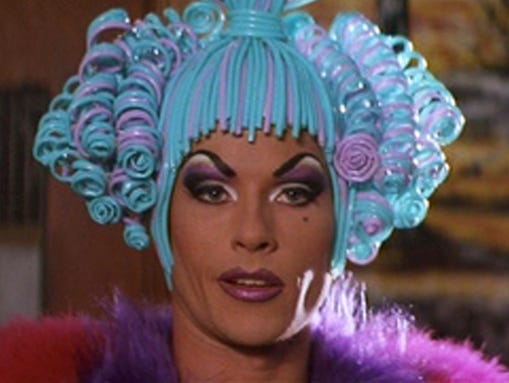
The intended audience of the film are middle-aged women and gay men, as they enjoy the music featured in the film, such as Abba, Gloria Gaynor, etc.  The film helped bring out a positive portrayal of the LGBT individuals, that helped to introduce LGBT themes to a mainstream audience.  However, the film has also been criticized for perceived racist and sexist stereotyping.  As seen from the female being portrayed as a Filipino who is Bob's wife.

2. Select a character and make notes on how they are presented:
  • Consider their physical characteristics and personality
  • How are they represented in terms of gender?
  • Are there stereotypes presented or challenged?
  • Is the representation positive or negative or a balance of both?

Character : Adam
Actor: Guy Pearce

Physical characteristics and personality:
  • Young
  • Flamboyant
  • Obnoxious
  • Immature
How are they represented in terms of gender?
Male - Young, very happy, excited
Drag Queen - Wants to cause trouble, flamboyant

Are the stereotypes presented or challenged?
  • Challenged as they are mocked in the film, where it is ultimately is personalized with the three individuals’ experiences in the outback. 
  • For example, in one scene that stands out in my mind is when Adam is chased and beaten up by a group of men who represent the stereotypical outback masculinity. 
  • I believe that the scene breaks down the stereotypes of drags queens and reveals them as individuals who go through struggles and face dire consequences for being true to themselves.
Is the representation positive or negative or a balance of both?
  • Balance of both

PRISCILLA QUEEN OF THE DESERT (PART A - NARRATIVE)

THE ADVENTURES OF PRISCILLA, QUEEN OF THE DESERT - PART A - NARRATIVE:

Questions:
  1. Is the narrative linear or non-linear? Is there any deviation from the structure?
  2. Identify the 5 stages of the narrative based on Todorov’s theory
  3. Are there any narrative strands in the film?
  4. Which binary oppositions can you identify in the film.

Answers:

  1. The narrative is non-linear, as it follows the journey of 3 drag queens but also has flashbacks which makes it non-linear.
  2. 5 stages of the narrative:

    •  A state of equilibrium. - Tick, Adam and Bernadette leave for a drag show in a bus.
    • A disruption of that order by an event. - Bus has been vandalized with homophobic hates and they are stuck in the outback.
    • A recognition of the disorder. - Bus breaks down and they meet a middle aged mechanic, Bob, and joins them on their journey.  Adam gets beaten up by a homophobic gang where he is saved by Bob and Bernadette.
    • An attempt to fix the disorder. - Tick and Marion have a son, and Tick is nervous about exposing his son to his profession and tries to get to know his son.  Tick is surprised that his son already knows about it and fully supports his career.
    • A new equilibrium - conclusion. - Tick, Adam, Bernadette climb Uluru in full drag costume. Tick and Adam head back to Sydney while Bernadette and Bob remains at the resort.
  3. Multi strand, as it focuses on 3 drag queens instead of 1.  As well later in the film Bob, the mechanic is also added into the plot.
  4. Good and Bad, Gay and Straight, Homosexual and Heterosexual